Blog No 10 Flying June Bug Kites

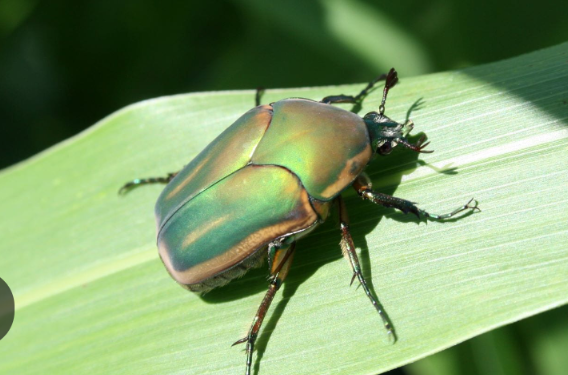
When the weather warmed up during the months of May and June at our homestead in Arkansas, swarms of June bugs would emerge from the ground, and take to flight, buzzing like a bumblebee. These beetles circled around the trees in our yard, careened wildly and glanced off objects, and somehow kept flying. Green June beetles (Cotinis nitida), as they are officially known, had just pupated from their ugly larval phase called grubs, into handsome green beetles. They wasted no time going about their business of mating. The male beetle has a metallic green color with a larger antenna, whereas the female is browner and bulkier, especially when carrying up to 30 eggs that are laid in the ground. June bugs measure about one inch in length, often described as clumsy, and have poor eyesight.
I don’t remember who taught us the game of flying a June bug. It was a two-person enterprise―one person held the beetle upside down, and the other person took a long piece of sewing thread, made a loop and placed it over one of their large hind legs. The June bug was then flown like a kite around in circles, tethered to the string we held in our hand. The beetle would soon wear out and land on the ground. At other times, the beetle was liberated when its hind leg was shorn off by the string attachment. The June bug kept flying and I don’t know if losing a hind leg harmed the beetle significantly.
This pastime has been written about by various authors, mostly from the South and in the Appalachian region. Dolly Parton writes about flying June bugs as a child in her autobiography. Many writers have observed that June bugs are no longer as abundant as in previous years. Green June beetles are harmless, do not bite you, and are fond of overripe fruit. The minor harm they may cause is the larva feed off roots for about three months as they mature underground.
I remember feeling a twinge of guilt when playing this game. A similar sport, more obscure and cruel, involves horse flies. My brother David recalls when we younger siblings accompanied our parents by train to visit our Freundschaft (used here to mean relatives) in southern Indiana where my parents grew up, the Amish boys caught horse flies and impaled a thin straw into the horse fly. The insect was allowed to fly away, armed with a straw antenna protruding from its body. David did not approve of the practice.
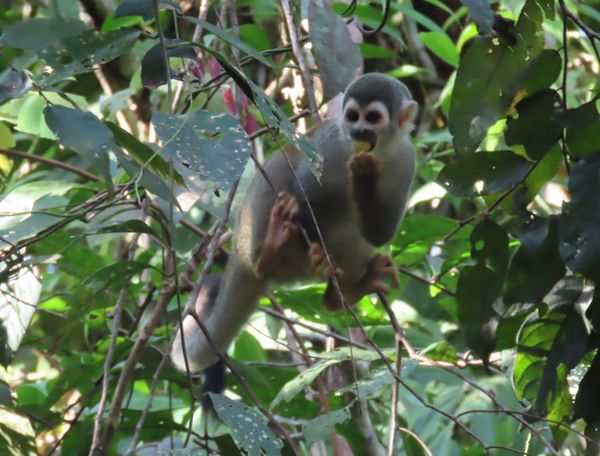
During my lifetime there has been a noticeable change, to our credit, in respect to how we treat animals, especially intelligent, higher life forms. Rhesus monkeys, crab-eating macaques, and squirrel monkeys, to name a few, are used in biomedical research, and have been used extensively to study head injury, to design helmets that provide better protection, as well as other aspects of injury to our nervous system. Baboons, with whom we share more than 90% of our DNA, are used to study traumatic brain injury and to study stroke by occluding the primate’s major arteries supplying the brain. How can I not be sympathetic to the movement that opposes this type of research? Admittedly, there is no better model to study brain injury, but I believe we should be cognizant of this moral dilemma .
The Netflix documentary “My Octopus Teacher,” gave me qualms about eating these creatures that clearly have a remarkable degree of intelligence. In the course of our existence, humans have made gradual changes to the betterment, in respect to treating other creatures more humanely, and we should make every effort to continue in this direction.
I recommend the biannual Wings, published by the Xerces Society, to learn about the fascinating and under appreciated world of the invertebrates. Although microorganisms and parasites are responsible for the most deaths in humans, this fact should not deter us from enjoying butterflies, moths, dragonflies, bees and the over 400,000 species of beetles that led evolutionary biologist J B S Haldane to observe that "God must have an inordinate fondness for beetles.".
* Images are not mine and were found on internet

Illustration of June bug kite*