My memoir is published!
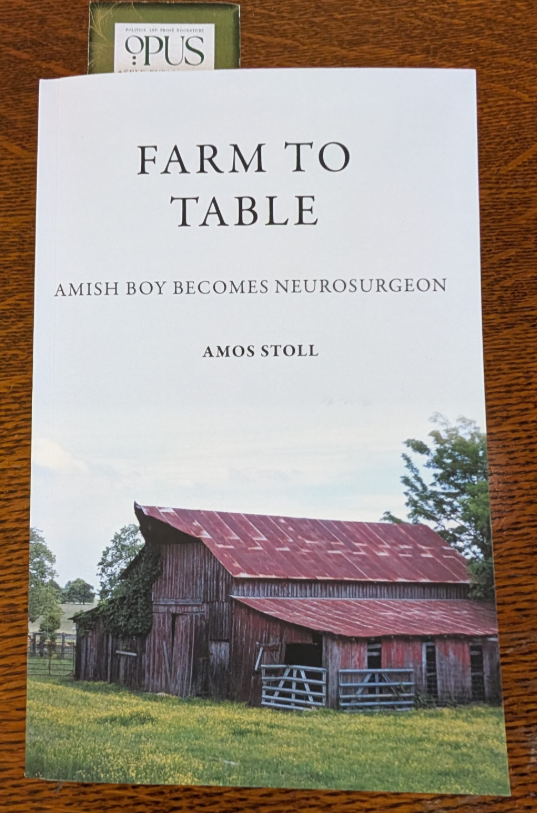
In the first half of my book I write about growing up in an Amish family on a farm in northern Arkansas. My parents lived in a traditional Old Order Amish community in Daviess County, Indiana, but they did not approve of some customs of the Old Order Amish. Along with a few other like-minded families (including our double-first cousins), they moved to southern Michigan, and established a new settlement. Still not satisfied, my parents made a more difficult move, this time to northern Arkansas where they formed a small community, consisting of three self-exiled, reform-minded families―two Old Order Amish, and one Old Order Mennonite. This settlement in time became larger, but never resembled the large Amish and Mennonite communities in Ohio, Indiana and Pennsylvania.
In this tiny settlement of plain people (a term for conservative Amish and Mennonites), my brothers and I worked the fields with a team of horses, cut sprouts from our recently cleared land, and harvested cane each fall to make sorghum molasses. In the spring, to augment our income, we took a hiatus from our farm to pick strawberries for a few weeks. We were paid seven cents per quart. The owners of the strawberry farm picked us up with our belongings and we traveled some 30 miles through the Ozark countryside to stay in migrant barracks while picking strawberries. This was a treasured time of the year as we were in constant contact with our Amish friends, and the crowning event was swimming in the nearby Buffalo River on Sundays. We picked strawberries with a few Black families, struck up conversations and sang gospel songs with them. They arrived in back of a truck, coming up from Little Rock, as they were not allowed to live in our area. We also picked strawberries with local Ozark families, but seemed to have less in common with them.
My brothers and I preferred to walk and rarely traveled by horse and buggy. During the part of the year when school was held in a small schoolhouse close to where our best friends lived, we walked two miles twice a day. We loved the outdoors, slept in a treehouse, hunted morel mushrooms, picked blackberries, and adapted to living with ticks and chiggers. We explored caves, identified animal tracks, and hunted arrowheads, but bird watching became our overarching hobby. My brother and I have continued this hobby, and over the years have taken weeklong trips to the tropics, exclusively engaged in birdwatching.
When our education ended with grade school, my two brothers and I immersed ourselves in self-help books, even meeting in a secret cave with our best friends to give lectures to each other and advance our education. I enrolled in the American School based in Chicago that allowed me to obtain high school credits by correspondence. This was a lengthy process and I eventually took a short cut by passing the GED exam and on this basis I was admitted to college. I kept a personal diary beginning at age 11 and continued writing in it faithfully until I entered medical school. These journals became the source for writing the first part of my memoir, and allowed me to use actual dialogue that I recorded at the time.
True to their Anabaptist heritage, Amish and Mennonites adhere to nonresistance or pacifism, which includes not serving in the military. The draft requirement was still in effect, but I fulfilled my obligation by working as an orderly and surgical technician at St. Anthony’s Hospital in Oklahoma City. Working in this medical environment inspired me to apply to medical school.
In the second half of my book, I write about medical school and after graduation I moved to Portland, Oregon for my internship. I had to wait a year to begin my residency in neurosurgery, so one of my professors arranged for me to work as a general surgery resident for one year at Jackson Memorial Hospital in Miami. On call every other night, I spent the year sequestered in the bowels of the hospital, losing all track of the outside world. For the first (and only time) I wondered whether I had made the right career choice. On a much happier note, I met my wife, Michele, during that year, and once we were settled in Portland for my residency, I knew I had made the right choice.
On our farm I learned how to innovate and adapt with only the essentials which proved useful in the modern operating room as a neurosurgeon. These same attributes were essential when I went for a week for two successive years on medical missions to Haiti after the devastating earthquake of 2010, where supplies were scarce.
I soon became embroiled in south Florida's litigious environment, where being sued was part of a neurosurgeon’s life. Some physicians lived in constant fear, changed how they practiced medicine, but I was able to adapt to it in a positive manner. I became a fan of London neurosurgeon Henry Marsh, who wrote two autobiographies about his life as a neurosurgeon; not only about his successes, but also about his surgical complications, which I emulate in my memoir. Along the way I write about lessons learned, useful knowledge I acquired, not only related to medicine and neurosurgery, but in other aspects that I wish to share with you.
My memoir has 470 pages, some 20 pencil sketches, and 18 pages of color photographs. It retails for $30.95 through Politics and Prose Bookstore in Washington, DC that you can order by using the link provided above.