Blog No 9 Birding in the Tropics
I was taught to identify birds from the paintings of the ornithologist, Louis Agassiz Fuertes, by my older brothers when I was 4 or five 5 years old. My oldest brother, Victor, was fanatically devoted to Purple Martins and claimed to have the largest colony of these swallows in the US (one year he had 729 nesting pairs) at his home in Finger, Tennessee. My brother, Ervin, shared a fondness for these martins, but was never able to lure them to nest in his boxes when he lived in Ohio; even after taking the desperate measure to cut down a huge shade tree in his front yard.
My younger brothers and I cut our teeth as birdwatchers while growing up on our farm in Arkansas, after we acquired a monocular and a Peterson field guide. Later, my brother Alvin and I reached our pinnacle of birdwatching, taking week-long birding trips to Costa Rica, Belize and Guatemala, Mexico, Panama, and Venezuela. We began birding at daybreak, and birded until dusk, studiously ignoring all other living things including butterflies, mammals, and trees. There were a few exceptions, such as when we encountered the terrifying jungle call of howler monkeys, or sighted a clownish-appearing sloth hanging by its toes from a branch high overhead. After these long days, it was especially rewarding to have a cold beer, and dine in an ethnic restaurant.
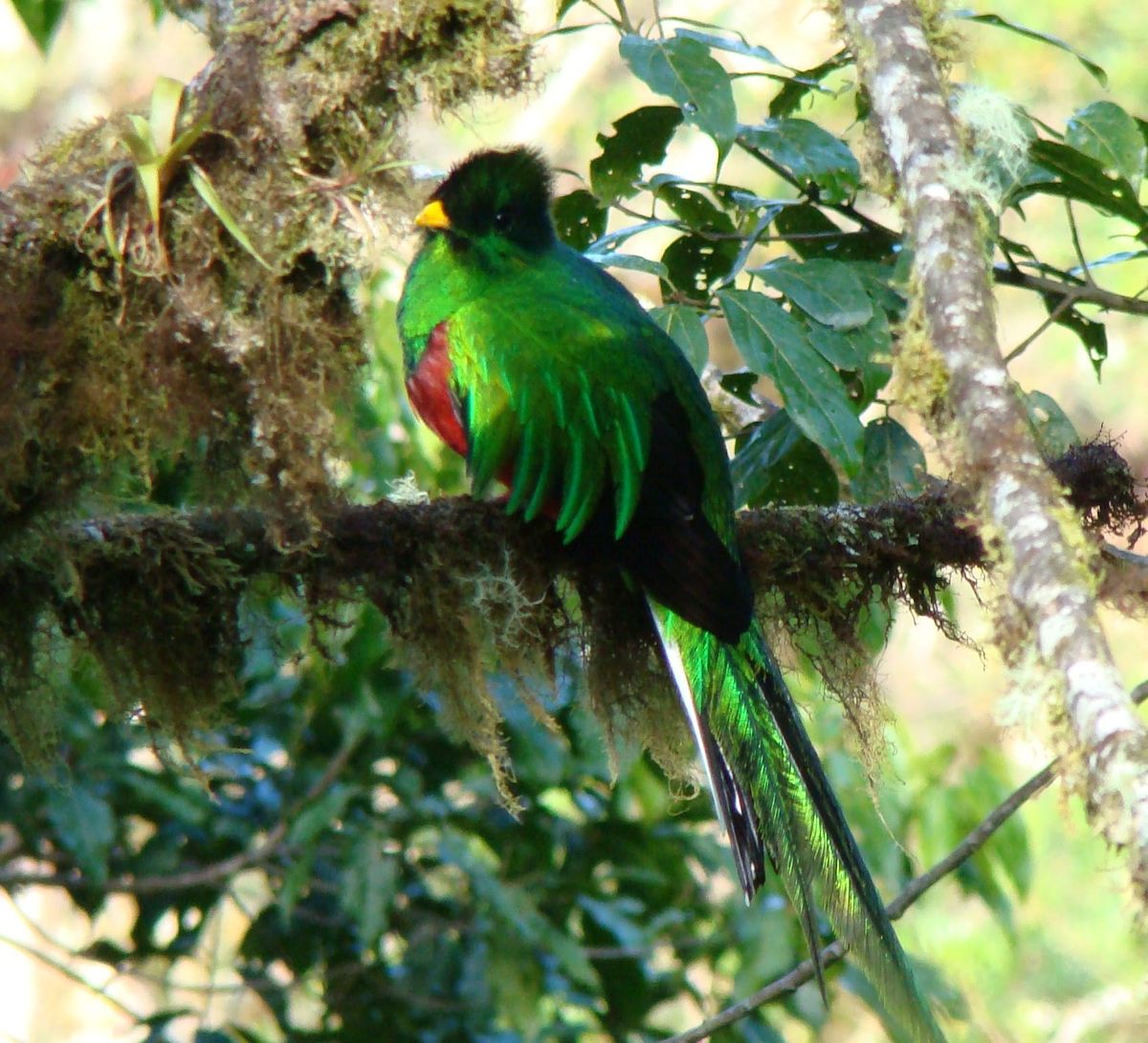
Our first tropical trip was to Costa Rica (1992), and the highlight was seeing the Monteverde Cloud Forest, created by warm, moist air from the Pacific Ocean rising and condensing into fog and mist when it reached the mountains, creating a profusion of moss, ferns, orchids and other epiphytes. The most desired bird to see is the Resplendent Quetzal, its long, exquisite tail feathers were used in headdresses of the Maya kings and nobles. We delighted in the melodic sound of the Three-wattled Bellbird that we heard from our lodge. We were able to identify only a handful of the over 20 species of hummingbirds that inhabit the preserve. Down on the Pacific coast we saw the Jabiru Stork, among other birds, and tried not be distracted by several species of monkeys that inhabited a park along the coast. In the deep jungle forests on the Caribbean side all was still, hearing only a few notes from high in the trees, but when we emerged from the jungle, the birds were abundant including noisy flocks of parrots flying overhead.
In Guadalajara, Mexico we rented a Volkswagen bus and headed for the Volcan de Fuego, Mexico’s most active volcano. We sped over a steep mound at the entrance of the trail (intended to keep us out?) and came upon meadows and trees along the road that was populated by familiar birds we knew from the States. At each higher elevation we encountered a new group of tropical birds. We camped one night along the way, and continue to bird until we reached a meadow in view of the volcanic cone, then turned around and headed for the coast.
On our first birding trip to Panama in 2005, we took delight in climbing the Canopy Tower, originally used as an US Air Force radar installation, but now prized for its lofty view. Birds flew into treetops at eye level, and we scanned the skies for raptors. We birded along the Pipeline Trail through dense jungle and tried to see the elusive Tinamou, a quail-like bird with a soulful call, but is rarely seen.
During our second trip to Panama, I obtained splendid photos of the Quetzal, and photographed a Black Guan lurking in a tree above us. As on other tropical birding trips, we became frustrated in trying to distinguish between a dozen species of flycatchers that differed only in the smallest detail. Another unique bird was the Great Potoo that sits camouflaged on a dead branch during the day, and scoops up insects with its wide gaping mouth during the night.
 |
| Resplendent Quetzal |
 |
| Black Guan |
We always felt safe on our birding trips except when we flew to Caracas, Venezuela. We ventured out to a restaurant near our hotel, and I remember Alvin had pasta with squid ink. Alvin had arranged for us to be picked up at our hotel and we were driven out into the llanos where we stayed in barracks built for the Llaneros. I was able to capture an image of a Scarlett Ibis in flight. Before dawn we heard the call of the male Yellow-Knobbed Curassow that sounds like a dive bomber but “without the thud at the end.” One morning after eating breakfast at our compound, I walked outside and became ecstatic when I saw a magnificent King Vulture sitting on a dead branch of a tree, holding court with a small contingent of Black Vultures. Each afternoon we were loaded on vehicle with other visitors and our guide took us out the llanos and marshes to observe wildlife. We were amused by a prehistoric looking bird called a Hoatzin with a spiky crest that frequents the wetlands. Another striking bird was a White-headed Marsh Tyrant.
 |
| King Vulture with Black Vultures |
 |
| Hoatzin |
 |
| Scarlett Ibis |
 |
| White-headed Marsh Tyrant |
In 1995 we flew to Belize City and caught a small prop plane to Chan Chich Lodge in western Belize. Ocellated Turkeys were common on the grounds. While walking along roads in the forest we saw a number of hawk species flying overhead and were thrilled to see our first White Hawk, almost entirely white with a black band on the end of its tail. We then made our way across the western border into Guatemala where we birded at the splendid Mayan city of Tikal. The following days we birded while exploring the vast, ancient ruins. On one night we climbed up the main temple called the Temple of the Great Jaguar, built around 730 CE, stands 154 feet tall, and faces the main plaza. When the sun went down and darkness enveloped us, it was impossible to climb down safely, so we sat on top of the ancient temple like Mayan priests, knowing that in an hour the moon would rise and illuminate the plaza, allowing us to climb down the stairs with ease.
In 2015, Alvin and I returned to Costa Rica, this time with our famous birding nephews, Ruben and Victor Stoll. The list we accumulated with them dwarfed anything we had accomplished on our own. In February 2025, we returned to Belize with our nephews Ruben, Victor, and Sam Martin. The first night at the birding lodge we were treated to seeing a Sphinx Owl, pointed out to us by a birder--an owl that Victor and Ruben had long searched for, but had never seen. We camped out one night in the Jaguar Preserve, and in early morning hours Victor used recordings of the owls that brought two species of owls into the trees about our tents, where they made frightening unearthly sounds. Alvin was awakened by the roar of a jaguar close by during the night, but no one else heard it. We birded along a forest trail where I observed numerous "highways" along which ants were carrying fragments of leaves on their way to their underground garden to feed their fungus colony. The ants did not eat the leaves, but dined on the fungi.
 |
| Leafcutter ant highway |