Blog No 6 Languages Spoken by the Amish
During their childhood Amish children learn to speak three languages―at least in some measure. Their primary language is Pennsylvania German that originated in the Palatinate region of southwestern Germany and was the language the Amish immigrants brought with them when the earliest settlers arrived in Pennsylvania in 1737. Unfortunately, this German dialect is also called Pennsylvania Dutch, not the Dutch of the Netherlands, but rather is a corruption of the word Deitch that means German in Amish dialect. Pennsylvania German is an oral language with no official written form. Writers, when attempting to write in Pennsylvania German, use spelling patterned after the German language. In my memoir I use phonetic spelling which requires the sentence to be read audibly before it can be understood. Non-Amish people from the Palatinate region of Germany also settled alongside the Amish, and spoke Pennsylvania German for years although speaking this language has slowly been lost with succeeding generations.
Amish children first hear English from non-Amish neighbors who are called “the English.” Amish children typically do not learn English until they attend school and by the time they reach adulthood they are reasonably proficient, but often have a slight accent. The third language that the Old Order Amish learn is an older version of German, used primarily in church services and in prayers and resembles the High German used by Martin Luther in his German translation of the Bible, although the Amish High German used for worship is influenced by Pennsylvania German. Church is held in their homes as Old Order Amish do not believe in church houses. In some Amish churches the minister may preach in English if attendees in the audience do not understand German. Other ultra-conservative Old Order Amish communities consider the English language to be "worldly" in itself, and are loath to use it in their worship, and certainly do not speak it among themselves in their homes. Amish men whose work exposes them routinely to outsiders become fluent in English whereas most of the Amish speak English only when necessary and prefer to speak in their mother tongue.
There are over 7000 languages that are spoken throughout the world and some are endangered; others are spoken by only a small number. More than half of the world’s languages are oral without a written version. Linguists have learned new languages should be learned before a child is past the age of 6 to 9 while their brains still retain their plasticity, if we wish to speak as a native speaker without an accent. Of course, there are exceptions.
The Amish dialect (synonymous with Pennsylvania German) has many versions. My sister-in-law, Esther from Berne, Indiana speaks Pennsylvania German with a Swiss accent, uses fewer English words, and her version sounds more pleasing. The Martin family we grew up with in Arkansas spoke a version closer to High German. Our family spoke the worst Amish dialect of all, a sort of Amish patois, riddled with English words. When English words are incorporated into the Amish dialect, they are given endings consistent with German grammar.
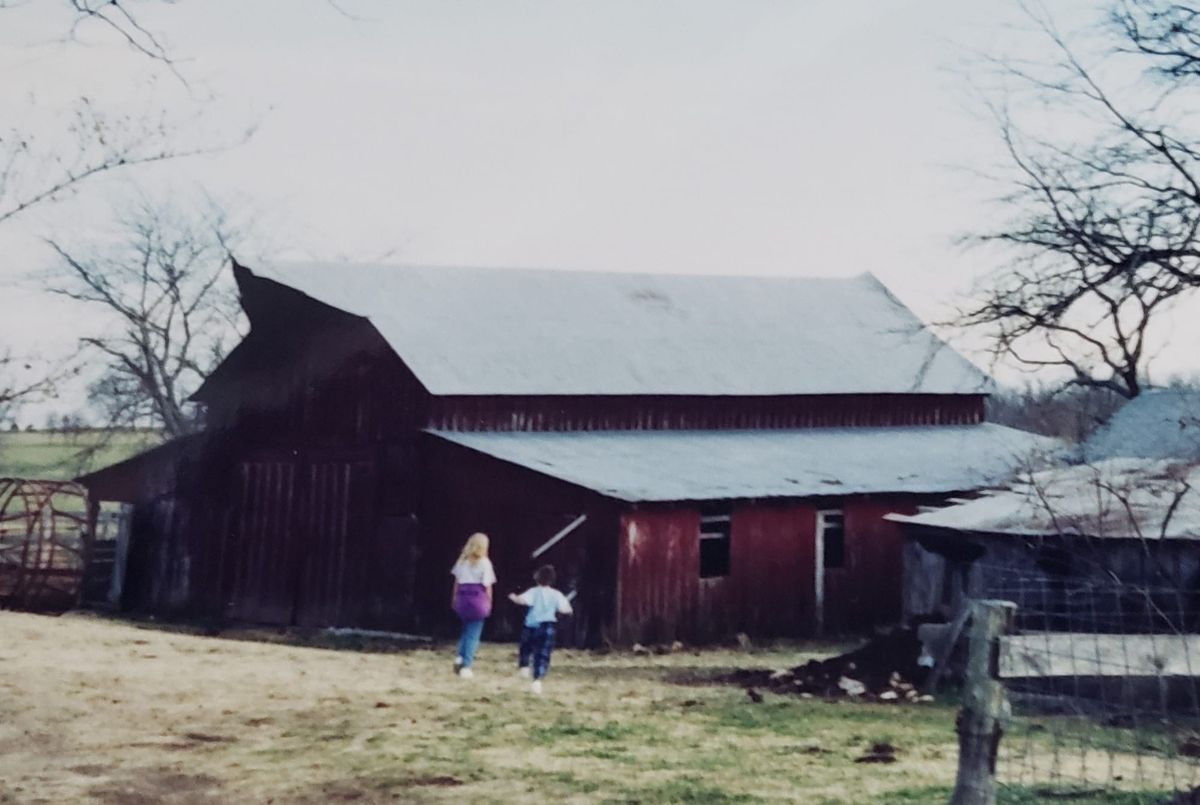
My two brothers and I with our best friends, the Wickey boys, decided in the winter of 1963 to mount an overnight camping trip to Boat Mountain, the highest mountain in our region. Admittedly, not a rational decision, as the seven of us spent much of the night shivering on the mountain since we had no sleeping bags or satisfactory winter gear. In the middle of the twenty-mile trek along country roads on our way to the mountain we suddenly decided to speak only English among ourselves and kept up the practice from that day forward.
Note: Next week I plan to be at Mt Nebo in Arkansas for Thanksgiving. Next blog on Dec 5
Photos by author