Blog No 31 Bible Translations


Michele and I recently visited the Congressional Library in Washington DC, the largest such library in the world, housing 2.9 million documents. It prominently displays the Gutenberg Bible (one of 21 copies still in existence) produced by Johann Guntenberg in Mainz, Germany in 1455, based on the text of St Jerome’s Latin Vulgate Bible, translated in the third century, and had been the primary Bible for over a millennium. Gutenberg used a printing press, similar to a wine press, using removable type. His invention not only transformed the production of Bibles, but revolutionized modern communication.
William Tyndale (c. 1494-1536) translated the first printed edition of the English Bible, drawing from Hebrew and Greek texts and received wide acclaim. This is especially true of Tyndale’s New Testament translation, published in 1526 during the time of the Protestant Reformation. There are only three known copies in existence. Tyndale was convicted of heresy, strangulated and burned at the stake. There is no consensus why Tyndale was martyred, but it cannot be entirely attributed to his translations, as his religious views were at odds with the Catholic Church, and he was critical of King Henry VIII’s attempt to annul his marriage.
The King James Bible (1611) became the definitive English Bible and has been described as the “noblest monument to English prose.” Biblical scholars relied on Masoretic Texts for the Old Testament (Hebrew Bible) and Greek editions for New Testament translations. For the latter, the King James scholars relied heavily on William Tyndales’s translation. The King James Bible wielded an overarching influence in religion and literature for over three centuries but over time there were more than 300 English words that changed substantially from their original meaning and was a justification for the Revised Standard Version published in the 1960’s, and made an appearance in our household.
Receded from our memory is King Phillip’s War (1675-1676), considered the bloodiest American war per capita, that unfolded in the lower New England states between the English settlers and the native American tribes of the Wampanoag, Narragansett and others. Metacomet, a Wampanoag chief known as King Phillip, led the native American forces in the conflict. John Sassamon, born into the Punkapoag tribe, orphaned at young age and raised in an English household, was converted to Christianity, and schooled at Harvard College. Sassamon served as an interpreter for the colonists to the Native Americans. Sassamon came under the tutelage of a Puritan missionary, John Eliot, who taught him English. Eliot is best known for his translation of the entire Bible into the Massachusett language, the first American Bible, published in 1663. John Sassamon was assassinated by native Americans for his role as an informant for the colonists, the tragedy serving as another catalyst for the King Phillip’s War.
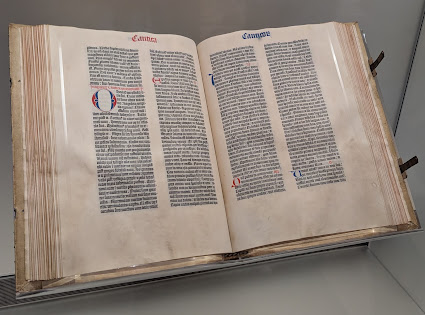
Gutenberg Bible
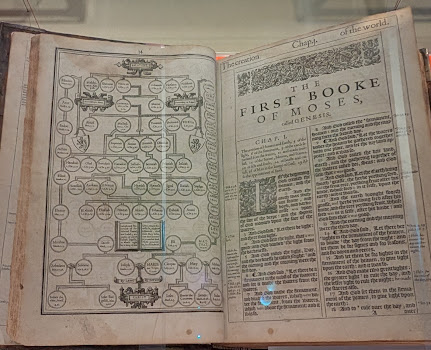
An early printing of King James Bible
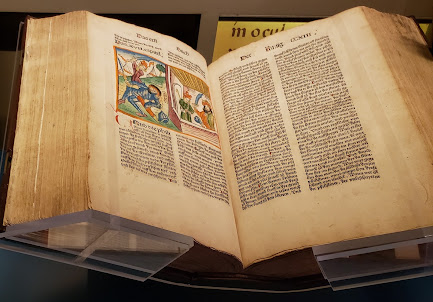
A German bible printed before Martin Luther's translation
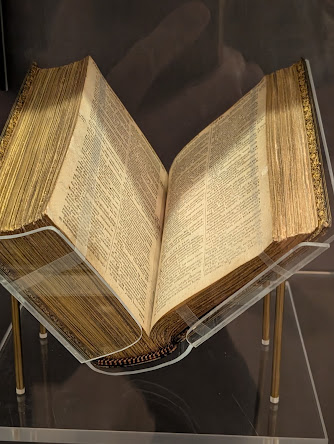
The Eliot Indian Bible