Blog No 21 The Screech Owls vs Honey Bees

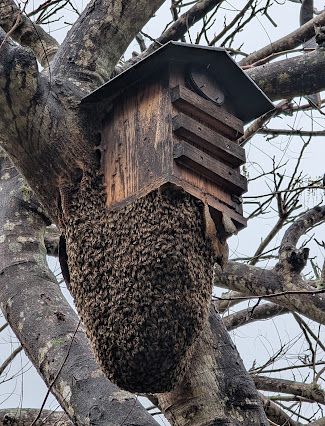

About 10 years ago I attached a birdhouse made for screech owls to the trunk of our large gumbo limbo tree in our front yard as I knew we had Eastern Screech owls living in our area. These owls as well as hawks and crows now live in cities as few people shoot them any longer as they did in the old days when I was growing up. The screech owl is one of our smaller owls and comes in two color morphs, grey and red. I've mostly seen the grey version in south Florida. The owl gets it's name from a shrill horse-like whinny. During breeding season the pair communicates in what is referred to as a trill and when I first heard it I mistook it for a toad calling.
Soon after I erected my owl house, I heard these small owls calling to each other early one spring and I was hopeful they would nest. I never saw them enter or leave the birdhouse, so it came as a complete surprise when one spring day I spotted two young owlets in one of our fruit tree in our front yard. The owls had nested without my knowledge! My good fortune was short-lived as a colony of squatter honey bees appropriated the owl's house. I hired a beekeeper to remove the bee colony, and he warned me there was a good chance a colony would return. True to his warning, a bee colony commandeered the owl’s residence before long.
I took down the original owl house, and each season I erected more houses for the screech owls. I attached one house to a 70-ft Royal Palm tree near our garage, and a pair of owls nested in it. I erected a box on the mango tree that borders our property, another in our sapodilla tree, and one in Royal Poinciana tree on our swale. Finally, I erected a house in our large lychee tree and one in our gumbo limbo tree in our backyard. Sooner or later, all the houses I erected for screech owls were colonized by honey bees. When the bees ran out of boxes, they constructed a free standing hive high on a branch of a mango tree! Another colony fashioned a hive on a branch of our gumbo limbo tree. I had never heard of this behavior in honey bees. It's not likely ideal as these colonies lasted only for a few years.
This year the house in the mango tree was no longer occupied by bees so I cleaned it out, hoping the screech owls will use it. On a hopeful note, a screech owl is now roosting each day on the exact same branch of our lychee tree. The dense foliage makes the owl virtually invisible, but I have not heard them calling so far but I'll keep my fingers crossed.
Postscript: After I had completed writing this blog, I drove up to my house after dark last night and I saw a screech owl scoop up a morsel from the street. In my driveway I heard the trill of its mate and I took a picture with a headlamp and my cell phone shown below.
All photos by author

Young screech owl in breadfruit tree

Colony outgrew house (Royal Poinciana)

Adult screech owl (Royal Palm tree)

Colony attached to gumbo limbo branch
(foliage is from sapodilla tree)

Free-standing colony high mango tree

Owl peering out of mango tree box (3.19.26)