Blog No 17 Aurora Borealis (Northern Lights)

The Milky Way on a moonless night devoid of light pollution or a ferocious thunderstorm with lightning and thunder should inspire awe in the most jaded mind, but the two natural phenomena that represent the best that Nature has to offer is a total eclipse of the Sun and a dazzling display of the aurora borealis. I have been fortunate to see the northern lights in Fairbanks, Alaska, in Iceland, on the frozen tundra outside of Yellowknife, Northwest Territory, and most unexpectedly, while on a canoe trip on the Current River in southeastern Missouri. The aurora is typically observed at 60 to 70 degrees latitude north and the display is caused by solar mass ejections that travel to the Earth and excite molecules of oxygen high in our atmosphere, causing green colors at lower altitudes (the most common color) but produce red hues when the sunbeam strikes oxygen molecules at very high altitudes (150 miles.) When the solar mass ejections strike nitrogen molecules at lower altitudes of about 60 miles above the Earth it produces hues of blue and purple. The strength of solar mass ejections correlates with the 11-year sunspot cycle of the Sun, that reached its peak in 2024 and is now in its declining phase. Unusually strong eruptions that can be seen in the lower United States occur during the peak of the sunspot cycle. A requirement to see a solar eclipse or the aurora is at least a partially clear sky.
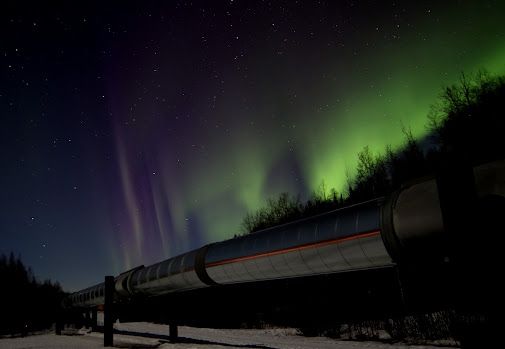
In 2015, Michele and I accompanied an organized aurora borealis excursion to Fairbanks, Alaska. The first night that we saw a major aurora exhibit we were stationed next to the Alaskan pipeline, when the show began around 11 PM and lasted until about 1 am. The most favorable time to see the northern lights is from around 11 pm to 1 or 2 am.
On one night our group gathered at a lodge at the summit of a ski slope. We drank hot chocolate and made periodic trips outside to the frigid temperatures and although we had a completely clear sky not even a glimmer of the aurora was visible the entire time. Around 1:30 to 2:00 am the crowd’s attention waned and our tour guide called it a night. Our bus made its way down a winding mountain road with groves of conifer trees blanketed in snow. A cry rang out and our driver luckily was able to pull into a turnout. Amidst the branches of bare trees and conifers a swirling green plume erupted over a distant ridge and kept billowing into the sky, eventually passing overhead. I set my camera on a tripod and excitedly took photos. After 30 to 45 minutes the edges of the aurora were less clearly defined, but the eerie, ghostly green and yellowish colors were still hanging in the sky when we got into our bus and departed in the middle of the night.
In March 2025, Michele and I visited Yellowknife, NWT, where we experiecd subzero temperature much of the time. A unique city with much to offer, my primary goal was to see the northern lights. During March there is an approximately 70% change of clear skies, although on the 5 nights we were there, there were gaps in the cloud cover only briefly and on one night it allowed my to photograph a dancing aurora with a moon eclipse that later became total.

Aurora forms rapidly at Alaskan pipeline

The two aurora displays in Alaska dwarfed all others in comparison

Arora appears miraculously at roadside stop

A second serpentine aurora develops

One last photo before leaving

Aurora in Yellowknife with moon eclipse