Blog No 15 Plants From the Age of the Dinosaurs

The cycads are an ancient group of plants that have survived to modern times. The oldest fossil evidence of cycads dates back to the Permian period, but it wasn't until the Triassic and Jurassic periods (200-65 million years ago) that these plants became the predominant flora on Earth and flourished along side with the dinosaurs. Modern species of cycad plants date back to Middle Miocene Epoch (16 to 11.6 million years ago.) About 300 species of these fascinating plants can now be found in the tropical and subtropical regions of Mexico, Central and South America, south Africa, Australia, China and Southeast Asia. Only one cycad is native to the US; it is called coontie (Zamia intergrifolia) by the Seminoles, and is found in south Florida and the West Indies.
Cycads are often confused with palm trees because of similar appearance but are not closely related to them. Cycads are classified as gymnosperms, meaning naked seeds, and are more closely related to conifers and ginkgoes, another ancient group of plants. The sago palm (Cycas revoluta) is the only common cycad widely planted in US, and survives in the USDA Plant Hardiness Zones 9 through 11. Cycads are dioecious plants meaning each plant is either female or male. The cones from male plants produce pollen, and the cones from a female plant form ovules than turn into seeds when pollinated.
Cycads grow slowly, reproduce infrequently but may live for a very long time; up to 1000 years. I have cycads plants from three genera, Zamia, Dioon, and Encephalartos. About once or twice a year my cycads will sprout a new groups of leaves at the apex of the trunk, called a flush. One or two of my Dione genus plants produced a cone. The plant must have well drained soil, and should not be over-watered.
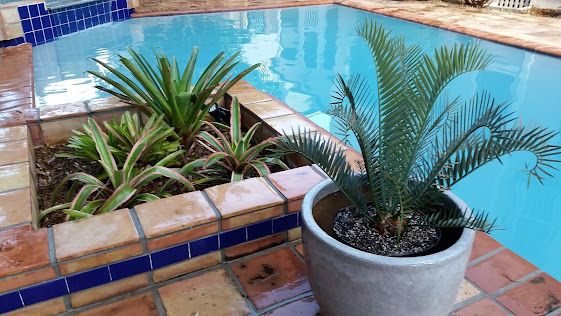
My most prized cycad is a bluish species called Encephalartos lehmannii that resides in a grey pot by my swimming pool. I cannot resist taking photos of its leaves that have an elegant, graceful curve at the end. When cycads are planted in the ground they may grow to a large size but remain relatively small when kept in a container. Encephalartos species are highly prized and are said to be vulnerable to poaching, but I have little concern about the fate of my robust Encephalartos ferox plant, as it is armed with sharp, ferocious spines on its dark green leaves that would keep any would-be cycad thief at bay.
An informative overview of cycads can be found at the University of Wisconsin's website
All photos by author

Encephalartos lehmannii

Encephalartos lehmannii

Dioon species with flush

Encephalartos ferox showing vicious thorns

Zamia species (do not have thorns)
.png)
Encephalartos ferox with a flush