Blog No 14 The Three Gorges of the Yangtze River


During 1990’s I was saddened when I read about the impending flooding of the Three Gorges on the Yangtse River in China, and resolved to see them before they were inundated. A massive new hydroelectric dam was under construction by the Chinese government, and the resulting reservoir would spoil forever the grandeur of these famous gorges. My family and I planned a three-week guided journey to China in August 2000 (through a tour operator, as individual travel in China was not yet feasible.) A portion of our grand China tour would be a riverboat excursion down the Yangtze River through the Three Gorges, embarking at Chongqing and ending at the industrial city of Wuhan. (Wuhan received notoriety during the Covid-19 pandemic.) A lingering image of Wuhan (and other parts of China) is that of a grey landscape with omnipresent yellow cranes projecting high into a smoggy skyline.
The Three Gorges Dam was first proposed in 1919 as a means to prevent recurring, devastating floods of the Yangtze River, and to generate hydroelectric power. Over the course of the massive 17-year project, roughly 60,000 workers took part. Work continued around the clock, seven days a week. The project displaced 1.1 million people; 1500 cities, towns, and villages were submerged as the dam was filled. Some 1300 known archaeological sites were flooded, although artefacts were salvaged before the dam was filled, if feasible. To prevent sediment to fill the lake bottom, the lowest sluices of the dam are opened during the summer months to allow water rich in sediment to escape. This has mitigated the buildup of sediment but the higher water flow results in increased erosion of the river below the dam. The dam has caused the loss or extinction of many species of fish. The giant Chinese paddlefish was declared extinct in 2020, the Yangtze sturgeon is “functionally” extinct, and the finless porpoise is critically endangered.
Critics of the dam believed the primary goals of the giant dam could have been achieved by construction of a series of smaller dams that would not have displaced as many people, nor submerged as much land. In the end the Chinese leaders chose Three Gorges Dam because it would be the world's largest dam, and would stand as an imperial monument to the developing nation.
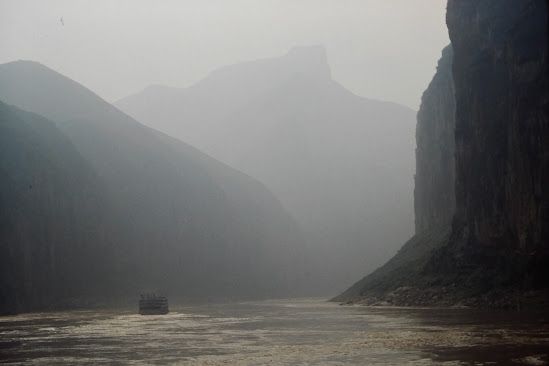
We boarded the Victoria Pearl riverboat at Chongqing, a port city that lies at the confluence of the Jailing and Yangtse Rivers. The next four nights we slept on board; during the day we lounged on the decks, taking in sights or reading. Our boat made a stop at an archeological site on the right river bank where vendors were hawking arts and crafts. We climbed up a steep slope and enjoyed a scenic view. On another day, we made a side trip in a small boat up a winding river through a narrow scenic gorge, surrounded by misty cliffs. The clear water was a welcome contrast to the muddy Yangtze..
Our Grand Canyon gorge is more pristine, its canyon deeper, and its celebration of colors is unsurpassed. In contrast, the Three Gorges are older, its canyon are wide and intimidating. Some vistas of the river and the gorge appeared as if set on another planet, grey, ghostly and other worldly.
All photos by author