Blog No 11 Trephination: Most Ancient Operation

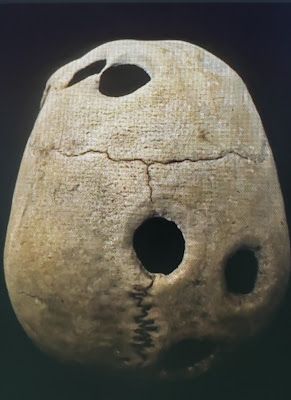
Over the centuries, humans have had an astonishing proclivity to cut holes in their heads. Known as trephination, it is the oldest operation we know about and was widely practiced by ancient surgeons. Other surgeries may have been performed but since soft tissues decay, the knowledge of such operations no longer exists. Since our skeletons survive indefinitely, paleontologist have unearthed knowledge of these ancient operations, and even know whether the patient survived. If the edges of the cranial opening were rough and uneven, the subject had died, but if the edges were smooth and remodeled, the patient survived.
The term for this ancient operation is trephination or trepanation. The two words are now used interchangeably, but their origin is derived from different techniques the surgeon used to make the opening in the skull. Neolithic surgeons performed trephinations in ancient Russia, China, Persia, Egypt, Greece, and other regions, and the practice continued into the Middle Ages and Renaissance period. We do not know why ancient surgeons performed trepanations but the standard explanation traditionally given was to “cast out demons,” for the treatment of epilepsy, mental illness, to suppress headache, and to remove "stagnant blood."
David Kushner, neurologist at University of Miami, reported the results of his study in World Neurosurgery (June 2018) of over 800 skulls that Inca surgeons had performed skull surgery from 400 BCE until 1400 CE. During the height of their skill before the Europeans arrived, the Incas had achieved a 80 to 90 percent survival rate. This prompted a New York Times article to report that Inca surgeons had a higher survival rate in brain surgery than Civil War surgeons. However, the comparison is unfair since Civil War soldiers likely died from their underlying brain injury, not from the craniotomy itself.
The astonishing high survival of the Inca surgeons is indisputable evidence they were consummate surgeons, had learned to stop bleeding from the skull (Sir Victor Horsley applied bees wax to the cut edge of the skull that advanced modern brain surgery), and had learned how to prevent infection, likely by using bacteriostatic plants. Inca surgeons performed trephination on all sexes and ages, but most were done on young men, many with skull fractures, suggesting they suffered head injuries from battle or perhaps while hunting, and were perhaps in a coma when the surgery was performed.
The conventional wisdom why this surgery was performed no longer invokes casting out demons, but recently it has become accepted that Inca surgeons were successful in treating head injuries with trephination. Plinio Prioreschi (1930–2014), a physician and medical historian who studied Neolithic skull surgery proposed a "unified theory," using all available data, that gives the best explanation why Inca surgeons performed skull surgery for nearly two thousand years. Prioreschi does not invoke effective treatment of head injury in his explanation. I explain his theory and and why this ancient practice was most likely not beneficial, in my memoir. Just because a treatment is performed over a long period dos not prove efficacy. Bloodletting was performed for over 3000 years, and was actually harmful.
.jpg)
TUMI used by Incas

Center hole is directly over sagittal sinus, if injured would be fatal
.jpg)